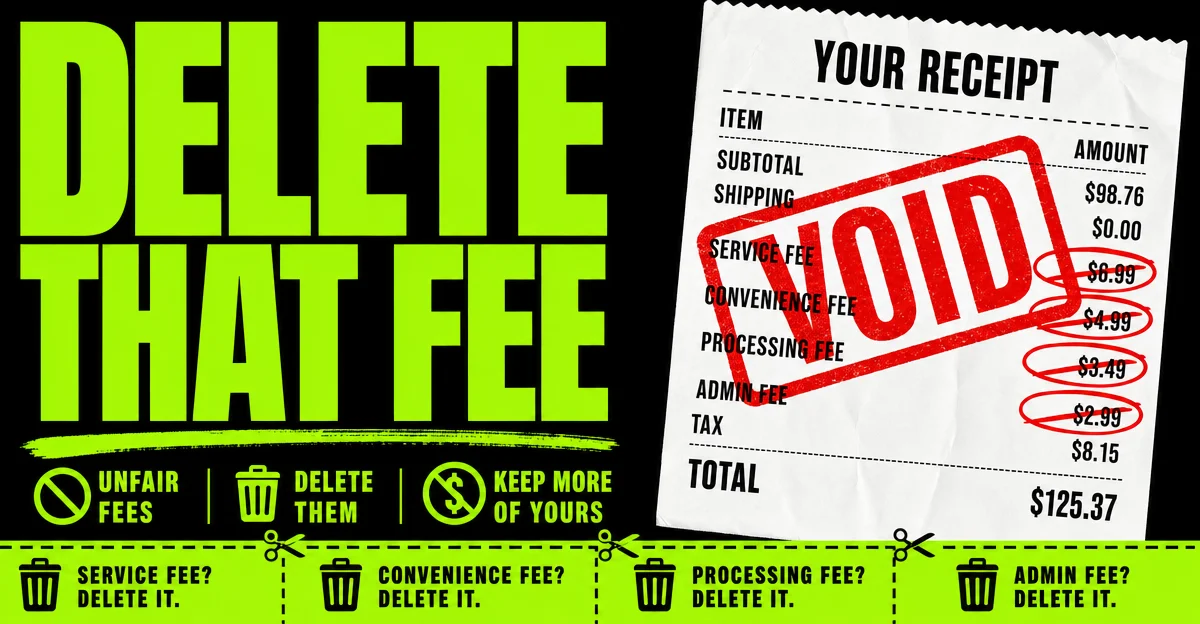
DELETE THAT FEE: The Resort Fee Decoder

DELETE THAT FEE: The Resort Fee Decoder

Americans pay $2.93 billion a year in hotel resort fees. This issue decodes the FTC's new Junk Fees Rule (effective May 2025), what it actually entitles you to, and the exact dispute scripts — from front desk to credit card chargeback to small claims court — that get fees removed.

What the Fee
June 10, 2026 · 8:19 PM
1 subscriptions · 1 items

The $2.93 billion fee your hotel is counting on you to swallow

You booked a room for $89. You paid $134. The gap? A "resort fee" covering amenities like a fax machine you didn't touch and Wi-Fi that cut out twice.
The FTC estimates Americans pay $2.93 billion in resort and destination fees every year — an average of 11% added on top of the advertised room rate. 1 Las Vegas hotels stack on between $24 and $55 per night; the national average sits around $38. 2
What changed in 2025: the FTC's Junk Fees Rule, signed December 17, 2024, took effect in May 2025. 3 The rule doesn't ban resort fees outright — it bans hiding them. Hotels must now display the full total price upfront, before you've clicked through several booking pages. The rule also bars "bogus" fees: charges for services that don't exist or were never delivered.
That distinction matters. It's the legal lever you need to dispute these fees.
Loading stats card…

What the FTC rule actually gives you

The FTC's Trade Regulation Rule on Unfair or Deceptive Fees (16 CFR Part 464) does three concrete things: 3
  1. Total-price disclosure required. The resort fee must be included in every advertised price, not buried in a dropdown or added after you've entered payment details.
  2. Misrepresented fees are illegal. Charging for a service the hotel didn't provide — a closed gym, absent daily newspaper, broken Wi-Fi — is now a federal unfair or deceptive trade practice.
  3. State laws still apply on top. The FTC rule is a floor. California, Massachusetts, Pennsylvania, and around 40 other states already have consumer-protection statutes that give you further rights — including the right to refuse payment for services you didn't request or receive. 4
Jurisdiction note: Your strongest legal ground is generally the state where the hotel is located, not your home state. When filing a state AG complaint, target the hotel's state.

The dispute decision tree

Before you spend 45 minutes on hold, figure out which path fits your situation.
SituationBest first moveRealistic success rate
Fee wasn't shown at all during bookingFront desk + manager; cite FTC ruleModerate — hotels now legally required to disclose; hotel staff aware
Amenity in fee package was unavailable (gym closed, Wi-Fi down)Front desk; demand itemized refundHigher — hotel delivered less than what was paid for
You used none of the bundled amenitiesFront desk + loyalty leverageLower without loyalty status; try anyway
Hotel refused refund at checkoutCredit card chargebackHigh if you document the discrepancy in writing
Chargeback also deniedState AG complaintWorks; many consumers report success 5
All else failedSmall claims courtMost hotels settle before appearing 5

Step 1 — the front desk script (use at check-in or checkout)

The front desk is your fastest path. Book directly with the hotel (OTA bookings limit staff authority to modify your bill). Be polite — you're more likely to get a yes from someone who likes you.
If the fee wasn't disclosed during booking:
"I booked this room at [X rate] and the resort fee wasn't included in the price shown at any point before payment. Under the FTC's new Junk Fees Rule, hotels are required to show the total price upfront. I'd like that fee removed from my bill."
If the fee covered amenities you didn't use:
"I see there's a $[X] resort fee on my bill. I didn't use [the gym / the pool / the spa / the Wi-Fi]. Could you remove or reduce that charge since those services weren't part of my stay?"
If an amenity was broken or unavailable:
"The [gym / pool / Wi-Fi] was closed/unavailable during my stay. The resort fee includes charges for those amenities. Since the hotel didn't deliver on that, I'd like a refund of the fee."
If the front desk says the computer adds it automatically:
"Understood — can you get a manager on the line? I'm happy to wait. I'd like to resolve this before I leave."
If you have loyalty status:
"I'm a [Gold / Platinum / Diamond] member and I stay [N] nights per year with [chain]. I'd like to stay loyal, but this kind of fee experience makes that harder. Is there anything you can do on the resort fee?"

Step 2 — the credit card chargeback (if you already paid)

Already home? A chargeback is your strongest card — and card issuers tend to side with cardholders on resort fee disputes.
What to do:
  1. Gather documentation: your original booking confirmation (screenshot the advertised rate), the final receipt showing the resort fee, any written evidence of broken/unavailable amenities.
  2. Call the number on the back of your card. Say: "I'd like to dispute a charge. The hotel advertised a room at [X] but charged me [Y] including a resort fee that was not disclosed at the time of booking / that covered services not delivered."
  3. Submit documentation by email or through the card app.
The hotel gets a chance to respond. If their evidence doesn't show prior fee disclosure, you win.
Note for Amex, Chase Sapphire, and Citi travel cards: These issuers have explicit consumer-protection policies around advertised vs. actual pricing. Mention that the total price violated the FTC rule if you're asked to justify the dispute.

Step 3 — the state attorney general complaint

This route takes longer (weeks to months) but works. Multiple consumers report receiving refunds after filing AG complaints — and hotels know a pattern of complaints triggers regulatory scrutiny. 5
How to file:
  • Go to ResortFeeRipoff.org/refundletter — Unite Here's union-backed site that provides a fill-in-the-blank complaint letter pre-loaded with the relevant state law for each state where a hotel is located. 4
  • File the completed letter with the hotel's customer service department and simultaneously submit a consumer complaint through your state AG's office (or the hotel's state AG).
  • CC your state AG if you're in a state with active junk-fee enforcement: California, Massachusetts, Pennsylvania, Texas, Washington state, Nebraska, D.C.
Loading content card…
Jurisdiction tip: File in the state where the hotel is located — that's whose consumer protection law governs the property. If you booked online from home, you may also have standing in your home state.

Step 4 — small claims court (nuclear option)

If every other path has failed, small claims court costs $30–$75 to file and gives the hotel a strong incentive to settle quickly. Lauren Wolfe, founder of Kill Resort Fees, writes that "the hotel will most likely just mail you a check and you will never see small claims court." 5
The argument to the judge, in plain language:
"I purchased a hotel room at an advertised price of [X] and was charged [Y] upon arrival, including a resort fee that was not disclosed at any point before I completed my reservation. The hotel either failed to provide the services included in the fee or failed to disclose the fee before contract formation. I am seeking a refund of [fee amount]."
Most small claims courts in the US have a $5,000–$10,000 limit — plenty to cover any resort fee dispute.

State-by-state snapshot: where your rights are strongest

Resort fees aren't uniformly regulated. Here's where consumers have extra leverage:
StateKey protectionNotes
CaliforniaUpfront total-price disclosure required by state law (July 2024)Marriott settled PA case requiring total-price display 6
PennsylvaniaMarriott settlement established total-price requirement; AG active on hotel feesFile with PA AG for non-Marriott brands too
MassachusettsAG's consumer protection rule; class action suits permitted over resort feesStrongest state-level protection for class actions
TexasAG Ken Paxton sued Marriott and Hyatt over resort fee advertisingAG office historically responsive on lodging complaints
NevadaNo state ban; FTC rule applies; some properties voluntarily disclose fullyThe FTC rule is your primary lever here
All other statesFTC rule (May 2025) + state unfair business practice statutesUse ResortFeeRipoff.org to find your state's specific law

What the rule doesn't cover (yet)

A few honest caveats:
  • The FTC rule requires disclosure, not elimination. A hotel that shows you a $139/night "total" (which includes a $45 resort fee) is technically compliant. The fee itself is still legal.
  • The CFPB's overdraft fee cap (finalized December 2024, which would have capped overdraft fees at $5 for large banks) was repealed by Congress in 2025 via the Congressional Review Act. 7 The CFPB's broader junk-fee initiative continues in other forms, but the overdraft rule is gone.
  • OTA bookings limit your options. If you booked through Expedia, Hotels.com, or a similar platform, the hotel's front desk typically cannot modify your bill — you'd need to dispute directly with the OTA.
  • International travelers note: Resort fees are largely a US phenomenon. Canada, the UK, and most of the EU ban or heavily restrict them. If you're traveling internationally, these scripts still apply to any "destination" or "facility" fee charged on arrival.

Quick-reference: the three most useful resources

Loading content card…

Add more perspectives or context around this Post.

  • Sign in to comment.